The Long Journey After
What the Interventions Missed
Thirty-five years ago, Dorothy began to notice a critical gap.
In her work at the US Congress and USAID, she has spent decades engaged with men and women who had survived unthinkable things: torture, unjust imprisonment, ethnic cleansing, trafficking, domestic violence. Organizations would step in, provide urgent help largely tied to time-limited programs. But Dorothy noticed a troubling pattern. The need for healing didn’t end when the intervention did. In many cases, the journey of healing was just beginning.
“Creating a safe environment that encourages human flourishing is multi-faceted. And, usually the journey of healing that needs to follow is long,” she reflects. “Someone needed to stay for it.”
That observation became a conviction. And that conviction became The Market Project.
Trauma is an event or circumstance resulting in physical, emotional or life-threatening harm with lasting adverse effects on functioning and well-being. Because the same incident can affect people differently, a trauma-informed approach focuses on assessing individual needs and providing tailored support — recognizing the widespread impact of trauma, understanding potential paths for recovery and actively resisting re-traumatization.
— Substance Abuse and Mental Health Services Administration (SAMHSA)
What healing actually requires
What Dorothy discovered through decades of practice and training, including Harvard’s Global Mental Health: Trauma and Recovery program, is that healing rarely follows a straight line, and almost never happens when a survivor remains in isolation.
Neuroscience offered one piece of the picture. Hands-on work, she learned, literally stimulates nerve growth in the brain and reduces anxiety. A stable job isn’t just income, it changes how the body responds. But, the job alone isn’t enough.
World-renowned trauma expert Richard Mollica, MD, articulated what Dorothy had been witnessing firsthand:
“For people threatened by violence, work becomes the anchor that holds them steady within their old world as a new one is being formed. …Work not only gives survivors an opportunity to earn money and be productive, but also a concrete time and place where they must show up, a familiar cast of friends, … and an overall sense of purpose and value.”
— Richard Mollica, MD, Healing Invisible Wounds
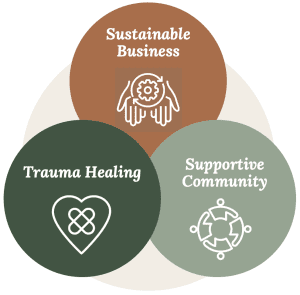
The Market Project adds key ingredients most programs leave out: the healing group, the supportive community, the invitation to tell your story in a place where it is safe to do so.
What a trauma-informed workplace actually does
Dorothy is careful to explain why this combination matters. For survivors of many types of trauma, she notes, the deepest wound isn’t only what happened, it’s the loss of voice and agency that followed. A trauma-informed workplace isn’t just good policy. It’s the restoration of something that was taken.
When psychological safety exists in a workplace, employees can raise difficult issues without fear. Managers can hear when a process is flawed. Team members are comfortable reporting a failure or sharing a best practice they have learned on their own. None of this is incidental. It is, Dorothy suggests, the difference between a job that stabilizes and a job that transforms.
BuildRight Construction Services, launching in Arua, Northern Uganda later this year, is designed to be exactly that kind of workplace. Local mental health specialists will partner with the program. Community leaders will be trained in trauma healing facilitation. Managers will be equipped to recognize warning signs of abuse, trafficking vulnerability and workplace harassment. The job created within a supportive community and the healing group will exist together, by design.
What keeps her going
What keeps Dorothy committed to this work, through the complexity, the patience required, is what she calls “a catalog of stories.” Stories of individual lives changed, relationships repaired, estranged relatives reconnected.
But the ones that stay with her most are the ones about the impact on a child’s life.
“We are seeing the cycle of generational trauma being ruptured,” she says. Mothers and fathers, having worked through their own stories of pain and betrayal, are raising their children with a new awareness, conscious of the impact that words and actions have on the next generation. Healthier ways of nurturing are being passed down instead of pain.
That is the ripple effect of our work. One person gets a job, joins a healing group and finds their voice, and the change doesn’t stop with them. It moves through their relationships, into their home and forward into the next generation. A parent-child relationship is healed. A community grows stronger. A child grows up differently.
Stay up to date on our impact
Join our email newsletter to hear stories of our work.